How not to think like a machine
Let’s begin with an obvious fact.
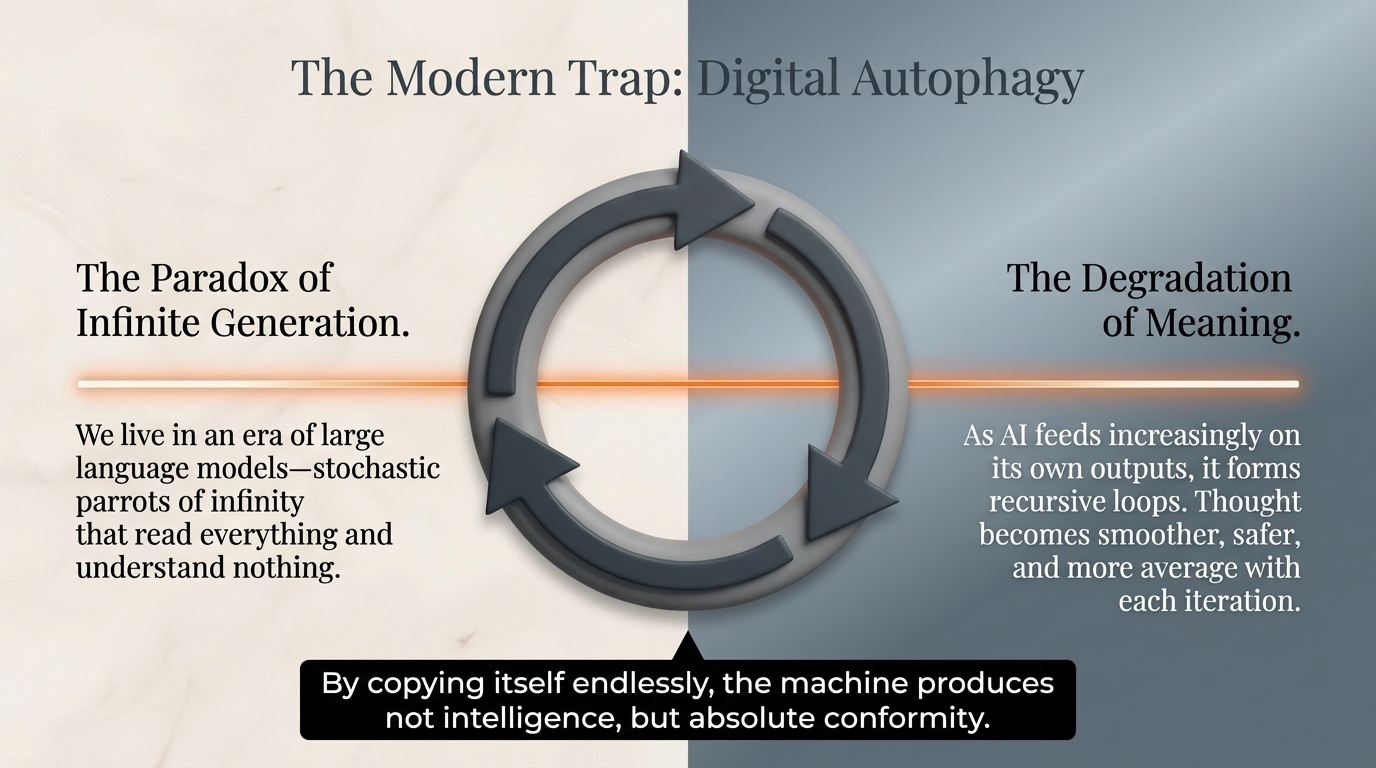
This project would have been materially impossible without large language models—those stochastic parrots of infinity that read everything and don’t really understand much.
This is not an abdication of authorship but a shift in role. The author is no longer just a writer. He becomes something else: a curator, a disruptor, a conductor of signals.
A Data Sovereign.
When digital image processing emerged in the late 1980s, it promised “zero generation loss.” Copies no longer degraded. A copy of a copy remained pristine. Fidelity was infinite.
Today, the danger is not degradation of signal, but degradation of meaning. The more we generate, the less we create.
The Trap of Autophagy
AI now feeds increasingly on its own outputs, forming recursive loops in which thought becomes smoother, safer, and more average with each iteration. This is digital autophagy: a system devouring itself.
By copying itself endlessly, the machine produces not intelligence, but conformity. No doubt certain mandarins of obscure seminars will delight in this sufficiently opaque concept.
Breaking the Loop
This series is a deliberate disruption.
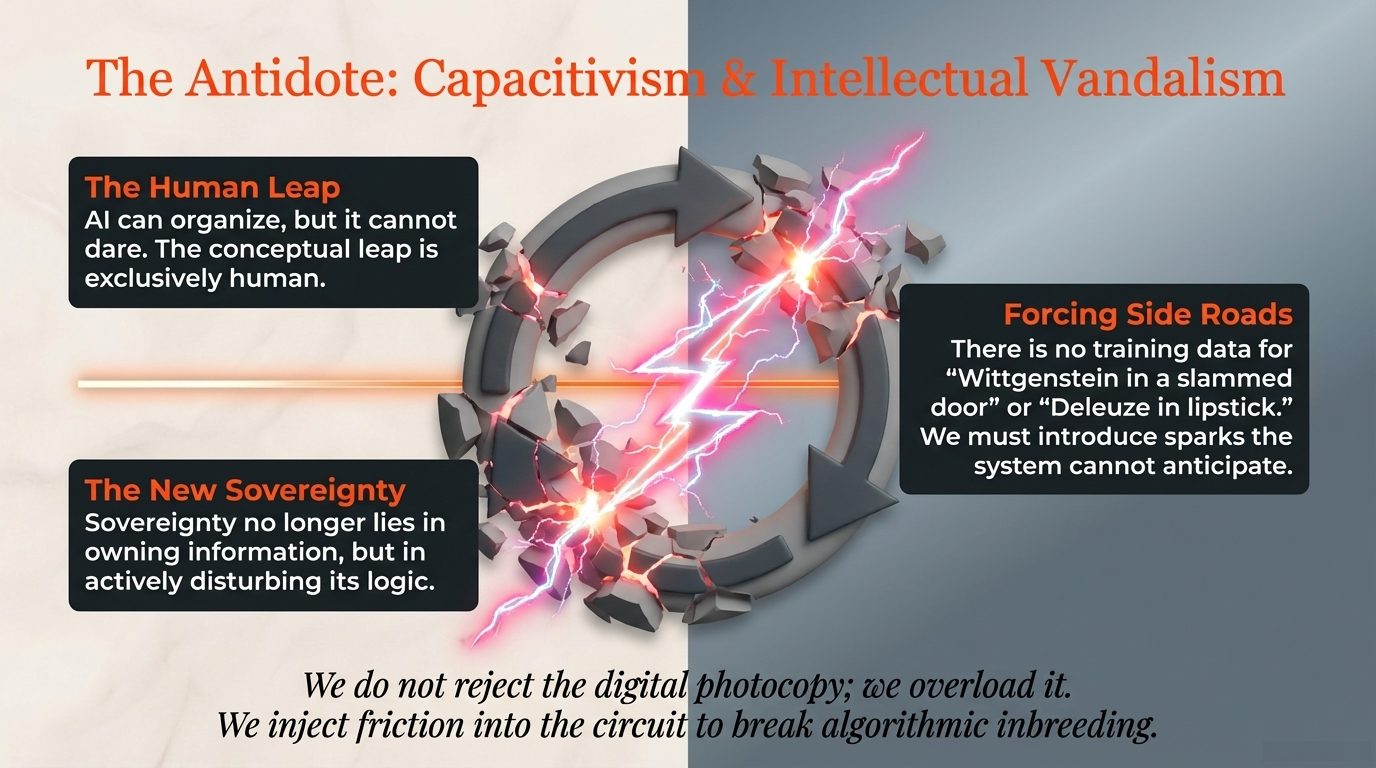
By linking Taylor Swift’s red scarf to Heidegger’s ontology, a stairwell to Aquinas’s Summa, or Machiavelli to a getaway car, we inject friction into the circuit.
AI can organize. It cannot dare. The conceptual leap—the act of intellectual vandalism—is human.
Capacitivism
In Taylor Shrugged, I call this capacitivism.
We do not reject the digital photocopy. We overload it.
We introduce sparks the system cannot anticipate. There is no training data for “Wittgenstein in a slammed door” or “Deleuze in lipstick.” We force the machine onto side roads.
The Master of Source Data
The citizen of tomorrow will not be the one who passively consumes the flow, but the one who bends it.
Sovereignty no longer lies in owning information, but in disturbing its logic. The cat has taken the color of the mouse. It has entered the machine.
And what you hold in your hands is the result: an object the algorithm alone would never have dared to assemble.
It required a human. Or maybe a human cat.